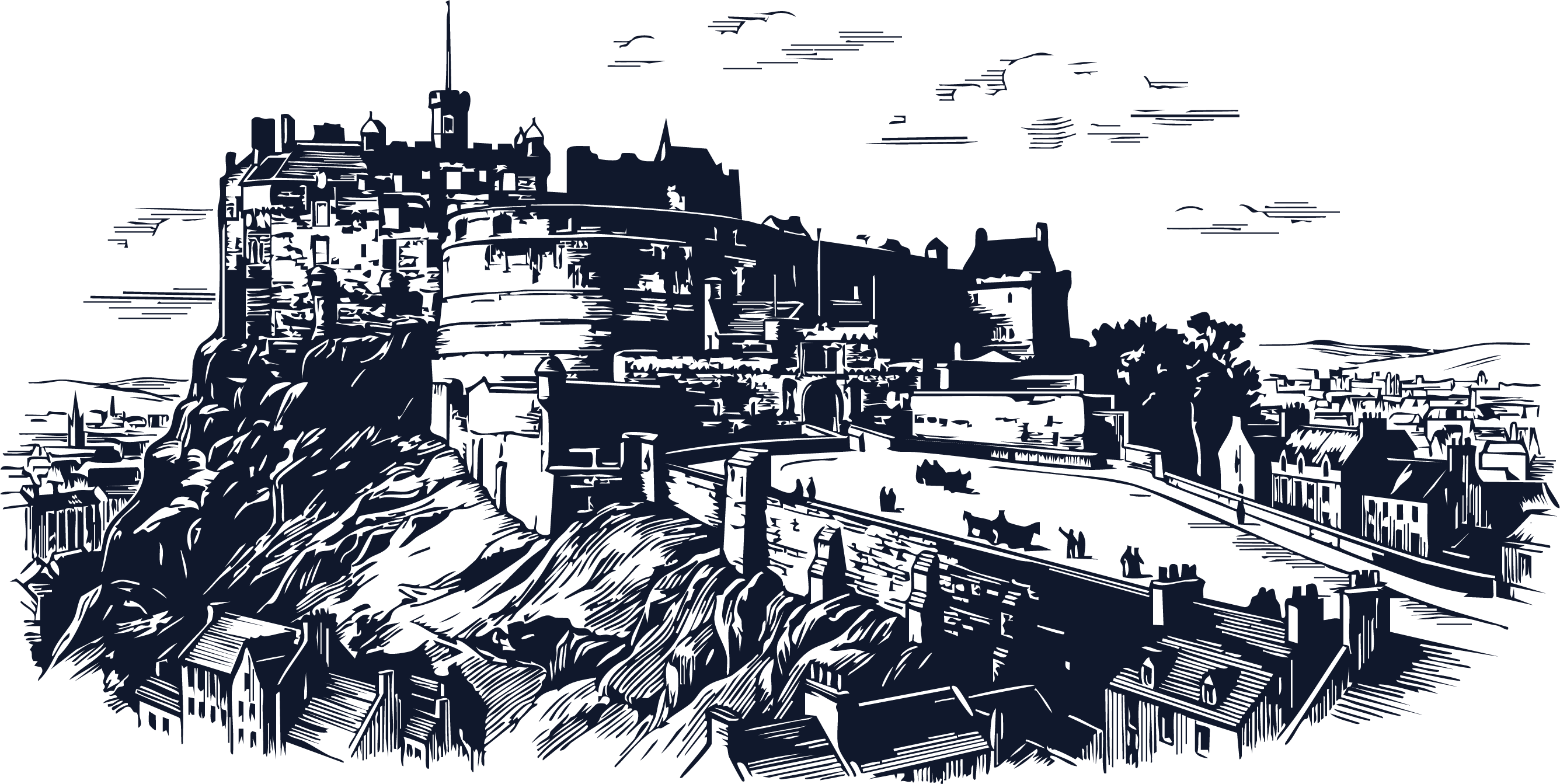
Edinburgh Castle is one of the most recognised landmarks in the United Kingdom. It sits on Castle Rock at the top of the Royal Mile, dominating the Edinburgh skyline from every angle. Today it is Scotland’s most visited paid tourist attraction, drawing over two million visitors in a single year before the pandemic. It is also a UNESCO World Heritage Site, an active military base, and the home of the Honours of Scotland The Scottish crown jewels, consisting of the Crown, Sceptre, and Sword of State. They are the oldest crown jewels in the British Isles. and the Stone of Destiny The ancient coronation stone on which Scottish and later British monarchs were traditionally crowned. Also known as the Stone of Scone. . But the castle you see today did not arrive fully formed. It was built up, torn down, besieged, rebuilt, and transformed across more than a thousand years of Scottish and British history. Understanding its story is a powerful way into understanding Scotland itself.
The Rock Beneath the Castle
Before there was a castle, there was the rock. Castle Rock is the remnant of a volcanic plug formed roughly 350 million years ago. The volcano itself has long since eroded away, but the hard dolerite core resisted glacial erosion and was left standing high above the surrounding landscape, a natural fortress before anyone thought to build on it.
Archaeologists have found evidence of human settlement on Castle Rock dating back to at least 900 BC, during the late Bronze Age. By around 600 AD, a Celtic people known as the Votadini A Celtic Iron Age tribe, also known as the Gododdin, who occupied much of what is now south-east Scotland and north-east England. They used Castle Rock as a fortified stronghold. , or Gododdin, had built a hill fort on the site. The oldest surviving Scottish poetry, the Y Gododdin, tells of a war band feasting at Din Eidyn, the fortress on the rock, for a full year before riding out to battle. It is one of the earliest references to the site in recorded literature.
The name Edinburgh itself derives from this early settlement. When the Angles invaded and took control of the rock in 638 AD, they knew it as Din Eidyn, which evolved over centuries into Edinburgh. The English name has been in use ever since, though in Scottish Gaelic the castle is still known as Caisteal Dhùn Èideann.
The Royal Castle: Malcolm III and Saint Margaret
The first clearly documented royal castle on the rock dates to the reign of Malcolm III King of Scotland from 1058 to 1093, also known as Malcolm Canmore. He was the first king known to have used Edinburgh Castle as a royal residence. in the 11th century. Malcolm used Edinburgh as a royal residence, and it was here that his wife, the deeply devout Queen Margaret, died in 1093, just days after learning of her husband’s death in battle.
Margaret was later canonised Formally declared a saint by the Catholic Church. as Saint Margaret of Scotland. Her son, King David I, built a small stone chapel on the highest point of the rock in her memory around 1130. St Margaret’s Chapel still stands today. It is the oldest surviving building in Edinburgh and one of the oldest in Scotland.
David I was a transformative king who did much to develop Edinburgh as a seat of royal power. He expanded the castle, founded the Abbey of Holyrood at the foot of the Royal Mile (creating what would become the other end of the great ceremonial street), and used Edinburgh as an administrative centre in ways that cemented the city’s importance to Scottish governance.
St Margaret’s Chapel is still used for worship today. It hosts weddings and christenings, and fresh flowers are placed inside it each week by a guild named in honour of Saint Margaret.
The Wars of Scottish Independence
Edinburgh Castle’s strategic importance made it a primary target during the Wars of Scottish Independence, the bitter conflict between Scotland and England that dominated the late 13th and early 14th centuries.
In 1296, King Edward I of England, known as the Hammer of the Scots A title associated with Edward I of England, who conducted aggressive and at times brutal military campaigns to bring Scotland under English control. , captured Edinburgh Castle after a siege lasting just three days. He removed the Stone of Destiny and took it to Westminster Abbey, where it would remain for seven centuries. The castle became an English garrison, a symbol of occupation rather than Scottish sovereignty.
The Scots fought to reclaim it. The most famous episode came in 1314, when Thomas Randolph 1st Earl of Moray and nephew of Robert the Bruce. He led the daring night raid that recaptured Edinburgh Castle from English hands in 1314. , a nephew of Robert the Bruce, led a small raiding party up the near-vertical north face of Castle Rock in the dead of night. The English garrison believed that approach to be impossible. Randolph’s men, guided by a soldier who had once used the route to visit a woman in the town below, scaled the cliff and overwhelmed the guards before they could raise the alarm. It is one of the most audacious military actions in Scottish history.
After recapturing the castle, Robert the Bruce ordered its walls demolished so that the English could never again use it as a garrison. The castle was substantially rebuilt in the following decades under King David II, and it changed hands between Scottish and English forces multiple times across the century. Research published in 2014 identified 26 sieges in the castle’s recorded history, giving it a credible claim to being the most besieged place in Great Britain and one of the most attacked in the world.
David’s Tower and the Black Dinner
In the 1370s and 1380s, the castle was substantially rebuilt under King David II and his successor Robert II. The most imposing addition was David’s Tower, a great L-shaped tower rising some 100 feet above the rock. It became the principal royal residence within the castle and a dominant feature of the Edinburgh skyline.
The tower witnessed one of the most chilling episodes in Scottish history. In 1440, the young King James II was just ten years old, and real power was held by Sir William Crichton, the Lord Chancellor. Crichton lured the teenage Earl of Douglas and his younger brother to a dinner at the castle. Midway through the meal, the severed head of a black bull was placed on the table, a signal of a death sentence. The two Douglas brothers were dragged outside and summarily executed in the courtyard, a brutal act of political elimination by a regent anxious to destroy a rival family’s power. The episode is known as the Black Dinner, and it is widely believed to have inspired the Red Wedding in George R.R. Martin’s A Song of Ice and Fire.
David’s Tower survived until the Lang Siege of 1573, when sustained artillery bombardment brought it crashing down. When the rubble was cleared and new defences were built on the site, the ruins were sealed inside the new structure. They were not discovered again until excavations in 1912.
Mons Meg and the Castle as an Arsenal
From the 15th century onwards, Edinburgh Castle’s role shifted increasingly toward military and administrative functions. It became Scotland’s principal arsenal and, for a time, its most important gun foundry.
In 1457, King James II received a gift from his ally Philip the Good, Duke of Burgundy: a massive siege cannon named Mons Meg A giant medieval bombard, or siege cannon, gifted to King James II of Scotland in 1457. Named after the Belgian town of Mons where it was made, it is now one of the best-preserved medieval guns in Europe. . The cannon weighed over six tonnes and could fire stone balls weighing around 150 kilograms. Mons Meg was used in active sieges until the mid-16th century, after which it served a ceremonial role. Its barrel burst during a celebratory firing in 1680 and it was subsequently taken to the Tower of London in 1754. It was returned to Edinburgh in 1829, where it remains on permanent display.
The castle also became the site of significant Scottish gunmaking. By 1511, Edinburgh had supplanted Stirling as Scotland’s principal gun foundry, with Scottish and European smiths producing artillery under the direction of master gunner Robert Borthwick. The quality of their work was acknowledged even by the English: at the Battle of Flodden in 1513, the English captured a set of Scottish cannons known as the Seven Sisters, and Sir Thomas Howard, England’s Lord Admiral, reportedly declared them among the finest guns he had ever seen.
The first recorded fireworks display in Scotland took place at Edinburgh Castle in 1507, when King James IV staged a spectacular jousting tournament that included a pyrotechnic display. The castle’s association with spectacular public events has never ended — it remains the backdrop to the Royal Edinburgh Military Tattoo every summer.
The Great Hall and the Royal Palace
Two of the most significant surviving medieval structures within the castle complex were built in the early 16th century under King James IV.
The Great Hall, completed in 1511, was designed for grand banquets and state occasions. Its most distinctive feature is its original hammerbeam roof, one of the finest examples of medieval timber construction in Scotland. Hidden in the hall is a small window above the fireplace known as the laird’s lugs (the lord’s ears), through which the king could eavesdrop on conversations taking place below. When Mikhail Gorbachev visited the castle for a conference in 1984, Soviet security services reportedly insisted the opening be bricked up before his arrival.
Tragically, James IV had little time to enjoy his new hall. He died at the Battle of Flodden in 1513, fighting forces sent by his brother-in-law Henry VIII of England. Flodden was a catastrophic defeat for Scotland, with the king and thousands of Scottish noblemen killed.
The Royal Palace, adjacent to the Great Hall, contains the small room where one of the most consequential royal births in British history took place. On 19 June 1566, Mary, Queen of Scots Queen of Scotland from 1542 to 1567. She was the mother of James VI of Scotland, who became James I of England in 1603, uniting the two crowns. gave birth to her son James in a room so small that visitors today are often startled by its size. That child would become James VI of Scotland and, in 1603, James I of England, uniting the two crowns for the first time. Above the door to the Royal Palace, the gilded initials MAH can still be seen, standing for Mary and her second husband Henry Stewart, Lord Darnley.
The Lang Siege and the Half-Moon Battery
The years following Mary’s abdication in 1567 plunged Scotland into civil war between those who supported the infant James VI and those who remained loyal to Mary. Edinburgh Castle became the final stronghold of the Marian cause.
Sir William Kirkcaldy of Grange, a celebrated Scottish soldier and loyal supporter of Mary, held the castle against the regent’s forces from 1571. The siege that followed, known as the Lang Siege The prolonged siege of Edinburgh Castle between 1571 and 1573, during the Scottish civil war following Mary Queen of Scots' abdication. It ended only when English artillery was brought in to bombard the castle. (Long Siege in Scots), lasted until 1573. It ended only when the English, at the regent’s request, sent heavy artillery to bombard the castle. The bombardment was devastating. David’s Tower collapsed. The medieval defences were largely destroyed. Kirkcaldy surrendered and was subsequently executed.
The ruins were cleared and an entirely new defensive structure was built on the east side of the rock. The Half-Moon Battery, the great curved artillery platform that is now one of the most distinctive features of the castle’s exterior, was constructed over the rubble of the fallen David’s Tower. It remains one of the most recognisable elements of the Edinburgh skyline.
The Honours of Scotland and the Stone of Destiny
The castle’s most treasured contents are the Honours of Scotland, the oldest surviving crown jewels in the British Isles. The Crown, the Sceptre, and the Sword of State together constitute the Scottish regalia, and they have been used at coronations for centuries.
During the Cromwellian occupation The period between 1650 and 1660 when Oliver Cromwell's forces controlled Scotland following the defeat of the Scottish army at the Battle of Dunbar. , the Honours were smuggled out of the castle and hidden at Dunnottar Castle on the Aberdeenshire coast, then secretly buried in the nearby Kinneff Old Church to prevent them falling into Cromwell’s hands. They survived the occupation and were returned after the Restoration of the monarchy in 1660.
After the Act of Union of 1707, the Honours were locked in a chest in the Crown Room and largely forgotten. They were rediscovered in 1818 at the instigation of the novelist Sir Walter Scott, who had obtained permission to search for them. The chest was opened and the crown jewels were found intact, exactly as they had been left over a century before. They have been on public display in the Crown Room ever since.
The Stone of Destiny, which Edward I had removed to Westminster in 1296, was returned to Scotland in 1996, exactly 700 years after its removal, and now sits alongside the Honours in the Crown Room.
The Castle as Military Prison
From the mid-18th century, Edinburgh Castle took on a significant new function as a prison for prisoners of war. The castle’s vaults beneath Crown Square, previously used as storage, were converted into holding areas for captives from Britain’s various military conflicts.
The first prisoners of war held there were French privateers captured in 1758, at the start of the Seven Years’ War. Over the following decades, prisoners from the American War of Independence, the French Revolutionary Wars, and the Napoleonic Wars were all held in the castle vaults. At peak capacity, hundreds of men were confined in conditions that were by all accounts grim. Graffiti carved by prisoners into the walls of the vaults is still visible today.
The military function of the castle did not diminish as its tourist profile grew. New barracks were constructed during the Napoleonic Wars, and the castle continued to serve as an active garrison throughout the 19th century and beyond. It remains an active military base to this day, home to the headquarters of the Army in Scotland.
The Jacobite Risings and the Castle’s Last Sieges
The Jacobite cause, which sought to restore the Stuart monarchy after the Glorious Revolution of 1688, repeatedly targeted Edinburgh Castle as the symbolic and strategic heart of Scottish government.
During the rising of 1689, Jacobite forces under the Duke of Gordon held the castle against the new government for several months. The castle’s garrison was eventually starved into submission. In 1715, another Jacobite attempt to seize the castle failed due to poor planning. The raiding party arrived with a ladder that was too short to scale the walls, one of the more undignified episodes in the castle’s long history of sieges.
The final siege of Edinburgh Castle came in 1745 during the Jacobite Rising led by Charles Edward Stuart, known as Bonnie Prince Charlie. Charles captured Edinburgh itself and occupied the Palace of Holyroodhouse, but he failed to take the castle. The garrison held out, and Charles eventually marched his army south toward England. After the Jacobite defeat at Culloden in 1746, the rising collapsed and the castle’s position as a government stronghold was never again seriously challenged.
The 19th Century: From Fortress to National Icon
The early 19th century saw a transformation in how Edinburgh Castle was perceived. It shifted from being primarily a military installation to being recognised as a monument of national heritage.
Sir Walter Scott played a pivotal role in this shift. His 1818 discovery of the Honours of Scotland was a public sensation. His organisation of the visit of King George IV to Edinburgh in 1822, the first visit of a reigning British monarch to Scotland in nearly two centuries, used the castle as a backdrop for a grand pageant of Scottish identity. Scott dressed the king in tartan and orchestrated a carefully stage-managed celebration of Scottish distinctiveness within the union, transforming the castle into a powerful symbol of Scottish national pride.
Throughout the 19th century, restoration work began in earnest. The Great Hall was restored. New visitor access was created. The Scottish National War Memorial, a solemn and architecturally remarkable building on the north side of Crown Square, was established in 1927 to commemorate the Scottish dead of the First World War. It remains one of the most moving spaces in the castle.
Edinburgh Castle Today
Edinburgh Castle today is managed by Historic Environment Scotland and functions simultaneously as a museum, a memorial, an active military base, and a major tourist attraction. Its various buildings span nine centuries of construction, from St Margaret’s Chapel in the early 12th century to 20th-century military additions.
The castle is the centrepiece of the Royal Edinburgh Military Tattoo, the annual festival held during the Edinburgh Festival in August. The Tattoo draws tens of thousands of spectators each year to watch massed pipes and drums perform on the castle esplanade, with the illuminated castle as their backdrop.
The One O’Clock Gun, fired from the castle six days a week at precisely 1 pm, is one of Edinburgh’s most distinctive features. The tradition began in 1861 as a time signal for ships in the Firth of Forth, allowing navigators to set their chronometers accurately. The gun still fires today, startling tourists and punctuating the city’s rhythm.
The One O’Clock Gun is fired Monday to Saturday. It is not fired on Sundays, Good Friday, or Christmas Day. A different gun, a 21-gun salute, is used for royal occasions.
Why Edinburgh Castle Matters for the Life in the UK Test
Edinburgh Castle features in the Life in the UK test as part of the broader coverage of Scottish history, British landmarks, and devolved culture. Candidates should know its significance as Scotland’s leading landmark, its connection to key historical figures including Mary Queen of Scots and Robert the Bruce, and its status as home to the Honours of Scotland and the Stone of Destiny.
Beyond the specific facts, the castle is a useful lens through which to understand the broader relationship between Scotland and England, the conflicts of the Wars of Independence, the Jacobite Risings, and the process by which Scotland’s distinct national identity was preserved and celebrated within the United Kingdom.
Conclusion
Edinburgh Castle has served as a fortress, a royal palace, an arsenal, a prison, a treasury, and a national memorial. It has been besieged more times than any other place in Great Britain. It has witnessed royal births and political executions, military disasters and audacious rescues. It has outlasted the kingdoms that built it and the sieges that tried to destroy it. Today it stands as one of the most vivid expressions of Scottish history anywhere in the world, and its outline against the Edinburgh sky is one of the most recognisable images in the United Kingdom.
- Edinburgh Castle sits on Castle Rock, the remnant of a volcanic plug formed roughly 350 million years ago, in the centre of Edinburgh.
- St Margaret’s Chapel, built by King David I around 1130 in memory of his mother, is the oldest building in Edinburgh and one of the oldest in Scotland.
- The castle has been besieged 26 times, more than any other place in Great Britain, earning it a claim as one of the most attacked sites in the world.
- Thomas Randolph recaptured the castle in 1314 by leading a night raid up the north face of Castle Rock, a route the English garrison believed was unscalable.
- James VI of Scotland was born in the Royal Palace in 1566. His mother was Mary, Queen of Scots. He became James I of England in 1603, uniting the two crowns.
- The Honours of Scotland (Crown, Sceptre, and Sword of State) are the oldest crown jewels in the British Isles and are kept in the castle’s Crown Room.
- The Stone of Destiny, the ancient Scottish coronation stone removed to Westminster by Edward I in 1296, was returned to Edinburgh Castle in 1996.
- Mons Meg, a giant medieval cannon gifted to James II in 1457, is on permanent display and is one of the best-preserved medieval guns in Europe.
- The Scottish National War Memorial within the castle commemorates Scottish soldiers who died in the First World War and subsequent conflicts.
- Edinburgh Castle is Scotland’s most visited paid attraction and forms part of the Old and New Towns of Edinburgh UNESCO World Heritage Site.