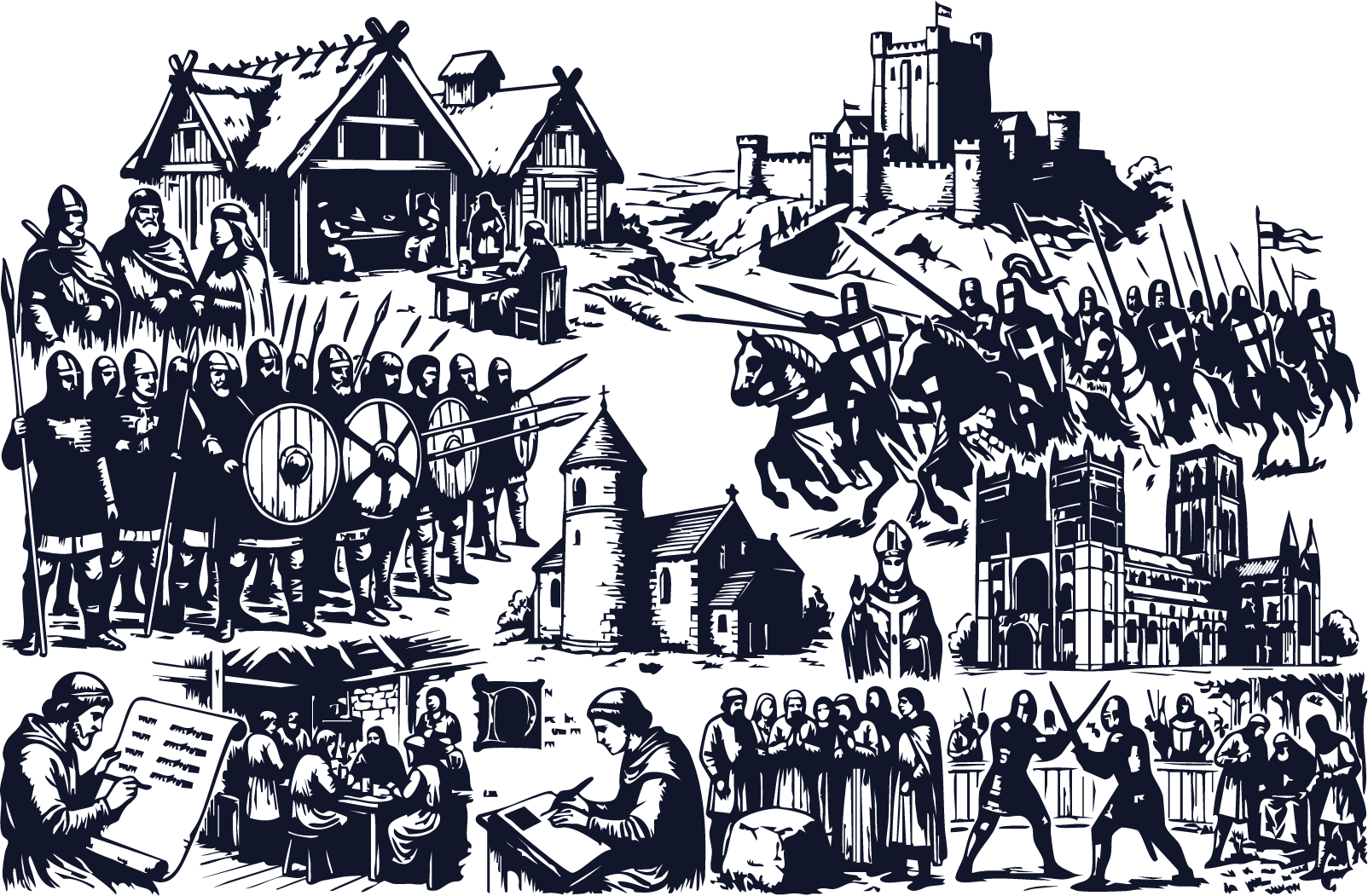
When William the Conqueror defeated King Harold at the Battle of Hastings in 1066, he did not simply replace one ruler with another. He fundamentally altered English society. The differences between Saxon England and the Norman world William imposed were stark, and their consequences shaped the language, law, land ownership, and culture of Britain for centuries. Understanding these contrasts is essential background for the Life in the UK test.
1. Language: From Old English to a French-Influenced Tongue
The Saxons spoke Old English The Germanic language spoken by the Anglo-Saxon inhabitants of England before the Norman Conquest, largely unintelligible to modern English speakers without study. , a Germanic language that formed the backbone of what would eventually become modern English. Words for everyday life, such as house, bread, child, and earth, are almost all Old English in origin.
The Normans spoke a dialect of Old French, and after 1066 it became the language of the court, the law, and the aristocracy. For roughly two centuries, England was effectively a bilingual society divided along class lines: French above, English below.
The long-term result was a hybrid language richer than either of its parents. English absorbed thousands of Norman French words relating to power, prestige, and refinement, including government, justice, parliament, beef, castle, and nobility. Meanwhile, the Anglo-Saxon words for the same animals that ended up on aristocratic tables survived in the mouths of the farmers who tended them: cow, pig, sheep.
2. Land Ownership: The Feudal System Replaces Saxon Customs
Saxon England had a complex but relatively distributed system of land tenure. Thegns, a Saxon noble class, could own land outright, and while the king held ultimate authority, land was not centralised under a single rigid hierarchy.
William dismantled this. He declared that all land in England belonged to the Crown, and redistributed it downward through a strict feudal system A social hierarchy where the king owned all land and granted portions to nobles in exchange for military service and loyalty. Those nobles could in turn grant land to knights and lesser lords. . His most powerful followers, known as barons, received large estates called fiefs Parcels of land granted by the king to nobles in exchange for military service and political loyalty. directly from the king. In exchange, they pledged military service and loyalty.
This was not merely a change in who owned what. It was a transformation in the concept of ownership itself. Under the Norman model, no one truly owned land in the Saxon sense. Everyone held it conditionally, as a grant from above. The consequences for English law and society lasted well into the modern era.
William commissioned the Domesday Book in 1086 to record exactly who held land, what it was worth, and what taxes were owed. It was a direct product of the new feudal order, and nothing like it had existed in Saxon England.
3. Architecture: Timber Halls vs Stone Castles
Saxon England was not without impressive buildings. Its monasteries, minsters, and royal halls were significant structures. But they were predominantly built in timber, and the Saxon aesthetic favoured decorated interiors over imposing exteriors.
The Normans built in stone, and they built to intimidate. Within years of the conquest, a network of castles began reshaping the English landscape. The Tower of London, begun by William himself, is the most famous example. These were not just military installations. They were visible, permanent statements of power designed to remind the English population who now controlled the country.
Norman church architecture followed the same logic. The grand cathedrals begun under Norman patronage, including Durham, Winchester, and Canterbury, were built on a scale that dwarfed anything Saxon England had produced. The Romanesque style An architectural style characterised by thick stone walls, round arches, and heavy piers, common in Norman buildings of the 11th and 12th centuries. they favoured, with its thick walls, rounded arches, and massive piers, expressed authority as much as faith.
4. Government and Administration: Greater Centralisation
Saxon England had a functioning system of government. The Witan The Witenagemot, an advisory council of senior nobles, clergy, and thegns who advised the Saxon king and had a role in selecting rulers. advised the king, and the country was divided into shires managed by local officials called ealdormen and, later, sheriffs. It was not a primitive system, but it was decentralised.
William kept some Saxon administrative structures, including the shire system, because they worked. But he fundamentally changed who wielded power within them. Norman barons replaced Saxon ealdormen. The church came under closer royal control. And crucially, William refused to allow any single baron to accumulate a geographically concentrated power base that might rival his own. English landholdings were deliberately scattered across multiple counties to prevent any Norman lord from becoming too independent.
The result was a more tightly controlled kingdom than anything the Saxons had operated. The king’s authority was more direct, more systematic, and more difficult to challenge. This concentration of royal power would be a defining tension in English political history for the next two centuries, culminating in the Magna Carta of 1215.
5. Religion and the Church: Continuity with a Change in Control
Both Saxons and Normans were Christian, so the conquest did not bring a change of religion. What it brought was a change in the personnel and culture of the English Church.
Saxon clergy, including many bishops and abbots, were progressively replaced by Normans. William appointed Lanfranc, an Italian-born Norman scholar, as Archbishop of Canterbury in 1070, and a systematic Normanisation of the senior church followed. Latin remained the language of worship, but the ecclesiastical networks now connected England more directly to Rome and to the broader Norman world in France and southern Italy.
The physical transformation of the church ran parallel to this. Almost every major Saxon cathedral was demolished and rebuilt in the Norman Romanesque style within a generation of the conquest. Whether this reflected Norman contempt for Saxon architecture, a desire for prestige, or simple practicality is debated by historians. The effect was that the physical fabric of English Christianity became Norman Christianity almost overnight.
Why These Differences Matter for the Life in the UK Test
The Norman Conquest is one of the most significant events covered in the Life in the UK test. Examiners are not looking for minute historical detail, but they do expect candidates to understand that 1066 was a turning point that changed the English language, restructured land ownership, introduced a new architectural legacy, and tightened royal control over both government and the church.
The contrasts between Saxon and Norman England are not merely academic. They explain features of modern English life that persist to this day, from the vocabulary of law and government to the castles and cathedrals that still define the British landscape.
Conclusion
The gap between Saxon and Norman England was wide, and it narrowed only slowly over generations as the two cultures merged into something new. By the 13th century, the descendants of Norman barons thought of themselves as English. But the five differences covered here, in language, land, architecture, government, and the church, were real and consequential. They are the reason 1066 is still the most famous date in English history, and the reason it remains central to understanding Britain today.
- 1066 was a turning point when William the Conqueror defeated King Harold at the Battle of Hastings and transformed English society.
- Language changed fundamentally as Norman French became the language of power, leaving English with dual vocabulary such as “cow” vs “beef” and “king” vs “royal”.
- The feudal system replaced Saxon land customs, with the king owning all land and granting it downward in exchange for military service.
- Normans built in stone, introducing castles and grand Romanesque cathedrals that physically reshaped England. The Tower of London was begun by William himself.
- The Domesday Book (1086) was commissioned by William to record land ownership across England, a product of the new centralised Norman administration.
- The Church was Normanised, with Saxon clergy replaced by Norman appointees. By 1100, only one English-born bishop remained.
- Norman administrative control was tighter than Saxon governance, with power concentrated in the Crown, laying the groundwork for later conflicts such as Magna Carta in 1215.