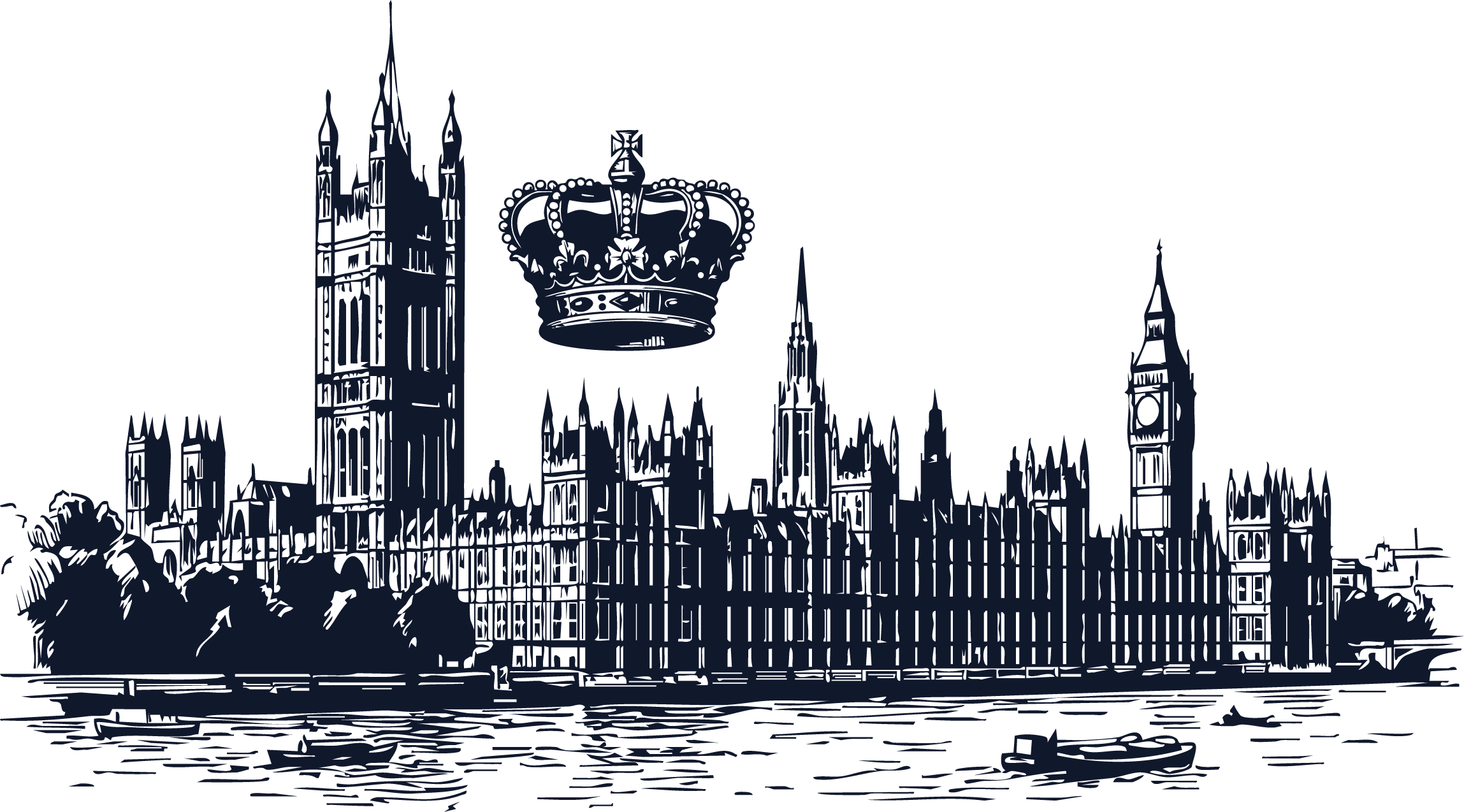
Britain today is a parliamentary democracy A system of government in which the executive derives its legitimacy from, and is accountable to, a legislature elected by the people. and a constitutional monarchy A system in which a hereditary monarch is the head of state but their powers are limited by law and convention, with real governing authority held by elected politicians. . The King is head of state. Parliament is sovereign. The Prime Minister leads the government. Laws are made by elected representatives and scrutinised by an unelected second chamber. It is a system that looks, on the surface, like it was designed. It was not. It grew, lurched, and was argued over across more than a thousand years of history, and it has never been written down in a single document. Understanding how Britain is governed today means understanding where that system came from.
How British Government Works Today
Before diving into history, it helps to have a clear picture of the modern structure. British government operates through three interconnected institutions: Parliament, the executive, and the judiciary.
Parliament is the supreme law-making body and sits at Westminster in London. It has two chambers. The House of Commons The elected lower chamber of Parliament, made up of 650 Members of Parliament (MPs) each representing a constituency. is made up of 650 elected Members of Parliament. The House of Lords The unelected upper chamber of Parliament, made up of life peers, hereditary peers, and Church of England bishops. It scrutinises and revises legislation but cannot block it indefinitely. is an unelected chamber of life peers, a small number of hereditary peers, and Church of England bishops. Parliament scrutinises the government, approves laws, and controls public spending.
The executive is the government of the day. The Prime Minister is the leader of the party that commands a majority in the House of Commons. They appoint the Cabinet, a group of senior ministers who collectively lead government departments. In theory the monarch appoints the Prime Minister, but by convention this is always the person who can command a Commons majority.
The judiciary is independent of both Parliament and the government. Since 2009, the Supreme Court of the United Kingdom has been the highest court of appeal, replacing the judicial role previously held by the House of Lords. Judges cannot strike down Acts of Parliament, but they can declare that laws are incompatible with the Human Rights Act.
Britain has no single written constitution. The constitutional rules that govern how power is distributed and exercised come from a combination of Acts of Parliament, common law, royal prerogative, and unwritten conventions.
The monarch The hereditary head of state. King Charles III has been monarch since September 2022. holds significant formal powers on paper, including the ability to dissolve Parliament, appoint ministers, and give royal assent to bills. In practice, all of these are exercised on the advice of elected politicians. The monarchy’s political role today is ceremonial.
This system has not always looked this way. To understand why it is structured as it is, you need to start roughly a thousand years ago.
Saxon Roots: The Origins of English Governance
The origins of English parliamentary government lie in the Anglo-Saxon period, long before England was a unified kingdom. Saxon society organised itself around local assemblies of free men who gathered to resolve disputes, allocate land, and advise local rulers. These were not democratic institutions in the modern sense, but they established a cultural expectation that rulers should consult and seek consent.
At the national level, the Saxon king was advised by the Witenagemot An assembly of senior nobles, clergy, and royal officials who advised the Anglo-Saxon king. The name means 'meeting of wise men'. , often shortened to the Witan. The Witan could not pass laws independently, but it played a genuine advisory role and had some influence over who became king when a ruler died without a clear successor. It was an embryonic form of counsel and consent, not a rubber stamp.
The Saxon system was also notable for its administrative sophistication. England was divided into shires, each managed by an ealdorman and later a sheriff, with local courts handling disputes according to customary law. When William the Conqueror arrived in 1066, he did not find a primitive society. He found one with functioning institutions, which he largely kept while placing his own people in charge of them.
The Norman Conquest and the Feudal State
The Norman Conquest of 1066 centralised power dramatically. William declared himself the owner of all land in England and distributed it downward through the feudal system in exchange for military service and loyalty. This made the king far more powerful than any Saxon predecessor, but it also created a new class of powerful barons whose support William depended on.
The tension between royal authority and baronial power would define English politics for the next two centuries. William and his successors needed the barons’ military support. The barons needed royal favour and protection. Neither side could afford to let the other become too dominant, and this mutual dependency created the conditions for the first great constitutional moment in English history.
Magna Carta (1215): The First Limits on Royal Power
By the reign of King John, baronial frustration with royal overreach had reached a breaking point. John had lost English territories in France, imposed punishing taxes, and treated his barons with open contempt. In 1215, a coalition of barons forced him to set his seal to the Magna Carta A charter signed by King John in 1215 that established, for the first time, that the king was subject to the rule of law. Latin for 'Great Charter'. at Runnymede.
Magna Carta was not a democratic document. Most of its 63 clauses dealt with feudal rights, taxation, and the grievances of barons and the Church. But buried within it were principles that would prove far more significant than their authors intended. Clause 39 stated that no free man could be imprisoned, dispossessed, or harmed except by the lawful judgement of his peers or by the law of the land. Clause 40 stated that justice would not be sold, denied, or delayed.
These principles, that the king is subject to the law and that individuals have rights the state cannot arbitrarily override, became the foundation on which centuries of constitutional development were built. Magna Carta was reissued and reaffirmed multiple times throughout the 13th century, and it became a touchstone that later reformers and revolutionaries cited whenever they needed to argue that arbitrary royal power was illegitimate.
Only three clauses of the original Magna Carta remain on the statute books in England today, but its symbolic importance to the development of constitutional government is incalculable.
The Birth of Parliament
The word “parliament” comes from the French parler, to speak. Early parliaments were not legislatures in the modern sense. They were occasions on which the king gathered his barons, bishops, and senior officials to discuss matters of state, and crucially, to grant taxes.
The critical development came in 1265, when Simon de Montfort, Earl of Leicester, summoned what is widely regarded as the first representative parliament. For the first time, it included not only nobles and clergy but also knights from the shires and burgesses from towns. This was a significant expansion of who had a voice in national affairs, though it was driven by political necessity rather than democratic principle. De Montfort needed broad support for his rebellion against King Henry III.
Edward I recognised the value of the format and made Parliament a regular institution. By the early 14th century, it had split into two chambers: the Lords, consisting of nobles and senior clergy, and the Commons, consisting of knights and burgesses. The fundamental structure of modern Parliament was in place, though it would take several more centuries before the Commons became the dominant chamber.
The Tudor Monarchy: Parliament as a Tool of Royal Power
The Tudor period, running from Henry VII’s accession in 1485 to Elizabeth I’s death in 1603, was paradoxically a time of both royal dominance and parliamentary development. The Tudors were powerful, centralising monarchs, but they understood that Parliament gave their decisions a legitimacy that royal decree alone could not.
Henry VIII used Parliament decisively during the Reformation. The break with Rome and the establishment of the Church of England were achieved through Acts of Parliament, most notably the Act of Supremacy of 1534, which made Henry the Supreme Head of the Church of England. By routing the Reformation through Parliament, Henry gave it legal force and involved the political nation in its consequences. Parliament was a tool of royal will, but it was becoming an indispensable tool.
Elizabeth I was a brilliant manager of Parliament. She consulted, cajoled, and occasionally overrode it, but she understood that governing without parliamentary consent on major matters was politically dangerous. By the end of the Tudor period, Parliament expected to be consulted on taxation and significant legislation. The expectation of consent was hardening into something closer to a constitutional requirement.
The Stuart Crisis: Parliament vs the Crown
The constitutional conflicts of the 17th century were the most violent in English history, and they permanently altered the balance of power between the monarch and Parliament.
The Stuart kings, James I and Charles I, believed in the divine right of kings The doctrine that a monarch's authority derives directly from God and is therefore not subject to earthly challenge or limitation. . Parliament believed that the king governed by consent and that taxation required parliamentary approval. The collision between these two views produced the English Civil War.
Charles I dissolved Parliament repeatedly, attempted to raise taxes without its consent, and eventually tried to arrest five members of the Commons in 1642. Parliament raised an army. The Civil War (1642 to 1651) ended with Charles defeated, tried for treason, and executed in 1649, an act without precedent in English history. England briefly became a republic, the Commonwealth The republican government that ruled England, Scotland, and Ireland from 1649 to 1660 following the execution of Charles I. , under the effective military dictatorship of Oliver Cromwell.
The monarchy was restored in 1660 with Charles II, but the constitutional questions had not been resolved. When his Catholic brother James II attempted to reassert royal prerogative and pack Parliament with his supporters, Parliament acted. In 1688, it invited the Dutch Protestant William of Orange and his wife Mary to take the throne. James fled to France without a battle being fought. This is known as the Glorious Revolution The largely bloodless transfer of power in 1688 in which James II was replaced by William III and Mary II, accompanied by a decisive shift in power from the Crown to Parliament. .
The Bill of Rights (1689): Parliament Becomes Supreme
The Glorious Revolution was followed immediately by the Bill of Rights of 1689, one of the most significant constitutional documents in British history. It established, clearly and permanently, that Parliament was supreme over the Crown.
The Bill of Rights prohibited the monarch from suspending laws, raising taxes, or maintaining a standing army without parliamentary consent. It guaranteed free elections and free speech in Parliament. It established that Parliament must meet regularly. In effect, it transformed England from a monarchy that tolerated a parliament into a parliamentary state with a constitutional monarchy.
From this point, the question was no longer whether Parliament or the Crown was sovereign. Parliament was sovereign. The question that would occupy the next two centuries was which part of Parliament held real power, and who got to participate in it.
- Magna Carta (1215) established that the king is subject to the law.
- The Model Parliament (1295) established the representative principle, including knights and burgesses alongside nobles and clergy.
- The Act of Supremacy (1534) made the monarch head of the Church of England, passed through Parliament.
- The Bill of Rights (1689) confirmed parliamentary supremacy and limited royal prerogative.
- The Act of Union with Scotland (1707) created the Kingdom of Great Britain and merged the Scottish and English parliaments.
- The Reform Act (1832) began the process of extending voting rights and reducing rotten boroughs.
- The Parliament Acts (1911 and 1949) reduced the House of Lords to a revising chamber with no power to block Commons legislation indefinitely.
- The Human Rights Act (1998) incorporated the European Convention on Human Rights into British law.
The 18th Century: Cabinet Government and Political Parties
The 18th century saw the emergence of the system of cabinet government that still operates today. As the monarch became less directly involved in day-to-day government, a senior minister began to coordinate government business and manage the Commons on behalf of the Crown. This role evolved into the office of Prime Minister.
Sir Robert Walpole is generally regarded as the first Prime Minister, serving from 1721 to 1742. He established the convention that the Prime Minister must maintain the confidence of the House of Commons to govern effectively. The king remained head of state and retained real political influence, but the practical direction of government had shifted to elected politicians.
The period also saw the hardening of political factions into recognisable parties. The Whigs broadly supported parliamentary power and Protestant succession. The Tories broadly supported the Crown and the established church. These were not disciplined parties in the modern sense, but they were the ancestors of the Liberal and Conservative parties that would dominate Victorian politics.
The 19th Century: Expanding Democracy
At the start of the 19th century, the right to vote was extraordinarily limited. Only men who owned property above a certain value could vote, and the system was riddled with anomalies. Rotten boroughs Parliamentary constituencies with very few voters, often controlled by a single wealthy patron who could effectively choose the MP himself. returned MPs on the votes of handfuls of people, while large industrial cities like Manchester and Birmingham had no representation at all.
The Great Reform Act of 1832 began the long process of modernising the electoral system. It abolished the worst rotten boroughs, redistributed seats to the new industrial towns, and modestly expanded the electorate. It did not create democracy, but it established the principle that representation should bear some relationship to population and that reform was possible through Parliament itself.
Subsequent reform acts in 1867 and 1884 expanded the franchise further. By the end of the century, most adult men could vote. Women were still entirely excluded.
The suffrage movement forced the question into the centre of political life in the early 20th century. After decades of campaigning, the Representation of the People Act 1918 gave the vote to women over 30 who met a property qualification. Full equal suffrage for women over 21 came in 1928.
The House of Lords and the Parliament Acts
Throughout the 19th century, the House of Lords remained a significant check on the Commons. It could and did reject legislation passed by elected MPs. The constitutional crisis came in 1909 when the Lords rejected the Liberal government’s “People’s Budget”, which proposed new taxes on the wealthy to fund social reforms.
The government called two general elections to secure a mandate, then passed the Parliament Act of 1911. This removed the Lords’ ability to block money bills and limited their power over other legislation to a two-year delay. A second Parliament Act in 1949 reduced the delay to one year. The Lords became a revising chamber, able to scrutinise, amend, and ask the Commons to think again, but unable to permanently block the will of elected MPs.
Further reform came in 1999 when most hereditary peers were removed from the Lords under the House of Lords Act. Today the chamber consists almost entirely of life peers, appointed on the advice of the Prime Minister and other party leaders, along with 26 Church of England bishops known as the Lords Spiritual.
Reform of the House of Lords remains unfinished and politically contested. The current system of appointed life peers has been criticised as giving Prime Ministers too much patronage power. Proposals for an elected upper chamber have been debated for over a century without resolution.
Devolution: A United Kingdom of Four Nations
The United Kingdom consists of England, Scotland, Wales, and Northern Ireland. For most of British history, all were governed directly from Westminster. This began to change significantly in 1999.
Devolution The transfer of powers from the central Westminster Parliament to regional assemblies or parliaments in Scotland, Wales, and Northern Ireland.created the Scottish Parliament, the Senedd (Welsh Parliament), and the Northern Ireland Assembly, each with varying degrees of legislative and executive power. Scotland has the most extensive powers, including control over health, education, justice, and some tax-raising powers. Wales has progressively gained further powers since its original assembly was established. Northern Ireland’s devolved institutions have a unique structure reflecting the political settlement of the Good Friday Agreement of 1998.
England has no equivalent devolved parliament, though there are elected regional mayors in cities including London, Manchester, and Birmingham with responsibility for transport, planning, and economic development. The question of English governance within the UK is a live and unresolved constitutional issue.
Westminster retains sovereignty and can in theory legislate for any part of the UK on any matter. In practice, a political convention known as the Sewel Convention A constitutional convention that the Westminster Parliament will not normally legislate on devolved matters without the consent of the relevant devolved legislature. means it does not do so on devolved matters without consent.
The Judiciary and the Rule of Law
British courts do not have the power to strike down Acts of Parliament in the way that, for example, the United States Supreme Court can strike down laws that conflict with the Constitution. Parliamentary sovereignty means that what Parliament enacts is law. The courts interpret and apply it.
However, the judiciary plays a vital constitutional role. Courts can declare that government actions are unlawful through judicial review A legal process by which courts examine whether decisions made by public bodies, including government ministers, are lawful. . They can declare that legislation is incompatible with the Human Rights Act 1998, which incorporated the European Convention on Human Rights into domestic law. While such a declaration does not automatically change the law, it creates significant political pressure on Parliament to act.
The Supreme Court of the United Kingdom was established in 2009, taking over the judicial function previously performed by the Law Lords sitting in the House of Lords. Its creation separated the judiciary from the legislature more clearly than before, reinforcing the principle of judicial independence.
The rule of law, the principle that everyone including the government is subject to and accountable under the law, is one of the foundational values of the British constitutional order, tracing its lineage directly back to Magna Carta.
The Modern Constitution: Key Principles
Britain’s unwritten constitution rests on a set of principles that have developed over centuries.
Parliamentary sovereignty is the cornerstone. Parliament can make or unmake any law. No Parliament can bind its successor. Courts must apply the law Parliament makes.
The rule of law means that everyone is subject to the law, that the law must be clear and accessible, and that disputes are resolved by independent courts.
The separation of powers in Britain is partial rather than strict. The executive sits within Parliament, not separately from it. But the judiciary is independent, and conventions prevent ministers from directing judges.
Constitutional conventions are unwritten rules that are politically binding even if not legally enforceable. The monarch’s obligation to appoint the leader of the Commons majority as Prime Minister is a convention. The collective responsibility of Cabinet is a convention. These conventions make the system work in ways that statute alone could not specify.
Responsible government means that the executive must maintain the confidence of the House of Commons. If the government loses a vote of no confidence, it must resign or call a general election.
Why This Matters for the Life in the UK Test
The Life in the UK test expects candidates to understand the broad structure of British government, the role of Parliament, the monarchy, and the Prime Minister, as well as key historical milestones including Magna Carta, the Bill of Rights, and the development of democracy. Questions typically focus on the roles and powers of different institutions, who can vote and how, and the significance of key constitutional documents and events.
What this guide has shown is that none of these institutions were designed from scratch. They evolved, were fought over, and were reformed across centuries. Understanding the history makes the present structure far easier to remember, because each element of it is the answer to a historical question.
Conclusion
British government is the product of a thousand years of argument between kings and barons, parliaments and monarchs, reformers and traditionalists. From the Witenagemot to the Supreme Court, from Magna Carta to devolution, every feature of the current system has a history behind it. Britain has never had a revolutionary moment that swept away the old and built the new from first principles. Instead, it has accumulated, revised, and reformed, building one of the most durable constitutional systems in the world on foundations that were never formally drawn up. That messy, incremental history is, in many ways, exactly the point.
- Parliament is sovereign and consists of the House of Commons (650 elected MPs) and the House of Lords (appointed life peers, some hereditary peers, and Church of England bishops).
- The Prime Minister is the leader of the party with a Commons majority and is the head of government. The monarch is head of state.
- Magna Carta (1215) was the first document to establish that the king is subject to the law.
- The Bill of Rights (1689) confirmed parliamentary supremacy after the Glorious Revolution and limited royal prerogative.
- The Parliament Acts (1911 and 1949) reduced the House of Lords to a revising chamber unable to permanently block Commons legislation.
- Women over 30 gained the vote in 1918 and women over 21 in 1928, achieving equal suffrage with men.
- Devolution in 1999 created the Scottish Parliament, the Senedd in Wales, and the Northern Ireland Assembly.
- The Supreme Court was established in 2009 as the highest court of appeal, separate from Parliament.
- Britain has no single written constitution. Constitutional rules come from Acts of Parliament, common law, royal prerogative, and political conventions.
- The Glorious Revolution (1688) established the principle that Parliament, not the monarch, holds ultimate political authority.